
In this article
- Why Venue-Specific DJ Experience Matters in Chicago
- What 'Preferred DJ' Really Means at a Venue
- Chicago Ballroom Wedding DJ Recommendations
- Load-In, Power, and Sound Rules Ballrooms Enforce
- Reading a Formal Ballroom Crowd
- Rooftop Venue Chicago DJ Recommendations
- Sunset Curfews and Outdoor Sound Limits
- Day Party Energy vs. Evening Reception Flow
- What Makes a DJ 'Venue-Ready' Beyond Just a Playlist
- How to Ask Your Venue About Preferred DJ Recommendations
- Questions to Bring to Your Venue Coordinator
- Booking a DJ Who Already Knows Your Chicago Venue
Every Chicago venue has a story about the DJ who showed up without a floor plan, ran the wrong power drop, and blew a fuse during the toast. Coordinators remember that DJ. They also remember the ones who load in quiet, hit their curfew, and read the room without being told. Couples researching a specific ballroom or rooftop aren’t just picking a vibe. They’re trying to avoid becoming the next story a coordinator tells.
Why Venue-Specific DJ Experience Matters in Chicago
A DJ who’s never seen your room is guessing. He’s guessing where the dance floor breathes, where sound bounces off marble, where the rooftop wind kills a subwoofer’s low end. Chicago venue DJ recommendations exist because coordinators have watched this play out enough times to know it matters.
The right DJ walks in already knowing the load-in door, the elevator schedule, and the exact minute the room goes from cocktail hour to first dance. That’s not luck. That’s repetition.
What ‘Preferred DJ’ Really Means at a Venue
“Preferred” doesn’t mean paid placement or a kickback deal. At most Chicago venues, it means a coordinator has watched a DJ work the room enough times to trust him without hovering.
Preferred DJ Chicago venues lists usually come down to three things: the DJ shows up on time, respects the venue’s sound and power rules, and reads the crowd instead of running a script. Coordinators build these mental lists room by room, wedding by wedding.
Chicago Ballroom Wedding DJ Recommendations
Downtown hotel ballrooms and formal event spaces run on tight schedules. Banquet staff need the room turned, the linens set, and the AV checked before doors open. A DJ who ignores that timeline creates problems for everyone else working the event.
A Chicago ballroom wedding DJ needs to know how these rooms actually operate, not just how to play music in them.
Load-In, Power, and Sound Rules Ballrooms Enforce
Most Chicago ballroom and hotel venues cap load-in windows to 60-90 minutes before guest arrival. That window shapes everything: how a DJ stages gear, where he runs cable, how fast he can soundcheck before guests start walking in.
Ballroom load-in at a downtown Chicago hotel looks nothing like a rooftop day party setup. Power drops sit in different spots. Elevators run on banquet schedules, not wedding schedules. Venue staff enforce noise curfews, not a written contract clause nobody reads. A DJ who’s worked the room already knows where the outlets are and which loading dock actually gets him to the ballroom fastest.
Sound rules matter too. Marble floors and high ceilings carry bass differently than a tented rooftop or a low-ceiling reception hall. A DJ with ballroom reps adjusts his system for the room instead of blasting the same settings he used at last week’s gig.
Reading a Formal Ballroom Crowd
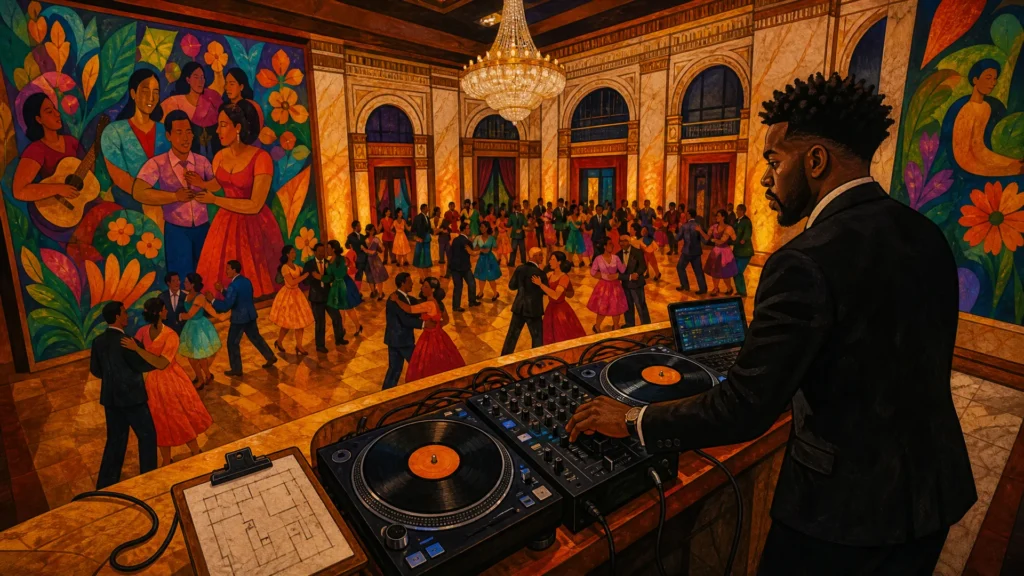
Ballroom weddings often run more formal than rooftop parties. Grandparents in the front rows. A structured timeline with toasts, a first dance, and a cake cutting on the clock. The DJ has to hold energy without forcing it, then build toward a dance floor that fills gradually instead of all at once.
This is close cousin territory to gala and fundraiser work, where formality and pacing matter just as much as the music. The instincts that make ballroom-ready gala sets work also apply to a formal wedding reception. Know the room, know the crowd, and never force a moment that isn’t ready yet.
Rooftop Venue Chicago DJ Recommendations
Rooftop weddings trade marble and chandeliers for skyline views and open air. That trade comes with its own logistics headaches, and a rooftop venue Chicago DJ has to plan around them before the first song plays.
Sunset Curfews and Outdoor Sound Limits
Rooftop venues in Chicago often enforce sunset sound curfews and outdoor power limits. Some properties cut amplified sound at a set hour regardless of what’s left on the timeline. Others cap decibel levels to avoid complaints from neighboring buildings.
A DJ who’s worked the room knows the curfew before the coordinator has to bring it up. He builds the reception timeline around it instead of scrambling when the sound tech taps him on the shoulder mid-set.
Weather is the other variable. Rooftop gigs need a contingency plan: covered equipment, a backup indoor space, or a shortened outdoor window if wind or rain moves in. A DJ with rooftop experience treats that as standard prep, not an afterthought.
Day Party Energy vs. Evening Reception Flow
Rooftop weddings often blend two moods in one event. A bright, casual day-party energy early on, then a more intimate evening reception as the sun drops and the curfew approaches. That shift happens fast, sometimes in under an hour.
A DJ has to feel that transition coming and adjust the set before the crowd feels the mismatch. That kind of read only comes from having stood on that specific roof before, watching how the light and the crowd change together.
For more on how that plays out in practice, live mixing for rooftop parties covers the same curfew and energy-shift challenges in more depth.
What Makes a DJ ‘Venue-Ready’ Beyond Just a Playlist
A playlist doesn’t know your curfew. It doesn’t know your grandmother just sat down or that the dance floor went quiet at 9:40pm because the transition was wrong. A pre-built set plays the next track no matter what’s happening in the room.
Live mixing is different. It means adjusting in real time: reading energy, watching the floor, changing the plan on the fly when a room does something a spreadsheet never predicted.
KMBRK has worked ballrooms, rooftop day parties, and nightlife rooms across Chicago since 2023. That range gives him a room-specific read on sound bleed, dance floor placement, and curfew enforcement that a generic booking can’t offer.
That distinction matters more at a specific venue than almost anywhere else. Venue quirks are exactly what a pre-built set can’t account for. The real difference between live mixing and playlist DJs breaks down why that gap shows up hardest under real venue pressure: a packed ballroom, a rooftop curfew, a room that isn’t behaving the way the timeline said it would.
How to Ask Your Venue About Preferred DJ Recommendations
Most Chicago wedding venue vendor lists aren’t advertised online. Coordinators keep them in their heads, or in a shared folder they only send when a couple asks directly.
Ask early. Venue coordinators talk to dozens of DJs a year. They know which ones handle the room well and which ones cause problems. That’s DJ experience at Chicago venues you can’t get from a website review alone.
Questions to Bring to Your Venue Coordinator
- Which DJs has this venue worked with before, and how did those events go?
- What are the venue’s load-in windows, power access points, and sound curfews?
- Has the venue had any issues with noise complaints or neighbor restrictions?
- Does the venue require a specific insurance certificate or AV sign-off?
- Is there a house sound system, or does the DJ need to bring full production?
These questions do double duty. They help you vet a DJ, and they help you understand your own venue’s rules before your vendor even shows up. For a broader version of this vetting process, questions to ask before hiring a Chicago wedding DJ covers the full list beyond just venue logistics.
Booking a DJ Who Already Knows Your Chicago Venue
Couples researching a specific ballroom or rooftop aren’t looking for a generic booking. They want someone who’s stood in that room, dealt with that curfew, and knows exactly where the dance floor comes alive.
KMBRK holds a 5.0-star rating across 19 Google reviews from Chicago weddings and events, several of them at the ballrooms and rooftops covered in this guide. That track record comes from treating every room as its own puzzle, not from running the same set on repeat.
If you want more on what separates a DJ worth trusting from one that just fills airtime, what to look for in top Chicago wedding DJs walks through the full vetting criteria. And if you want to see why that rating holds up, why KMBRK holds a 5.0-star rating breaks down the reviews themselves.
If your venue is on this list, or close to it, the smartest move is a conversation before you lock in a date. Book a Chicago wedding DJ with live mixing experience and get someone who already knows your room, your curfew, and how to keep your floor full from first dance to last song.