In this article
- Why a Fashion Show in Chicago Needs a Live DJ, Not a Playlist
- How a Runway Show DJ Times the Music to Every Look
- Building a Cue Sheet From the Running Order
- Holding, Extending or Cutting a Cue When the Schedule Slips
- Working With Producers and Stylists Before Showtime
- What the Producer and Stylist Hand Over
- Rehearsal, Soundcheck and Show-Day Changes
- Choosing Genres That Match a Fashion Brand's Identity
- Blending R&B, House and Afrobeats Across One Collection
- Pre-Show and After-Party Energy: Keeping the Room Moving
- Doors-Open Sets That Let Guests Talk and Still Feel the Room
- The After-Party Pivot When the Last Walk Ends
- Pop-Up Shop DJ Sets and Live DJ Work for Retail Events
- DJ for a Model Casting Event: Steady Sound for Start-Stop Rooms
- Booking a Fashion Show DJ in Chicago: What to Send for a Quote
- Frequently asked questions
- How much does a DJ for a fashion show in Chicago cost?
- Can the same DJ play the runway and the after-party?
- What if the designer wants certain tracks, or bans others?
- Are you a Chicago DJ, and can I hear your work first?
Search for a DJ for a fashion show in Chicago and you get wedding pages. Party DJ pages. A stock photo of a dance floor and a promise of “all the hits.”
That’s not what a runway needs. A runway needs someone who can hear the show breathe.
I’m DJ KMBRK. I’ve mixed live behind the decks in Chicago since 2023, and I read the room instead of pressing play on a pre-built playlist. Here’s how that method works when the room is a runway.
Why a Fashion Show in Chicago Needs a Live DJ, Not a Playlist
A party DJ runs on the party’s clock. A runway runs on the show’s clock, and the show’s clock moves.
Models walk at their own pace. A stylist needs ninety more seconds on one look. The designer wants a longer pause before the finale. A playlist doesn’t know any of that, so it keeps playing while the show moves out from under it.
A playlist can’t read a room. On a runway, that means the track ends in the wrong place, the beat drops on an empty catwalk, or the closing look walks out into silence.
I work the other way. I follow the running order and watch each walk, and I move the music when the show moves. That’s the whole job.
I’ll be straight about where I come from. My track record is ballrooms, rooftop day parties and nightlife rooms across Chicago, and my 5.0-star Google rating rests on 19 reviews from those events. Those spaces test one skill again and again: walk into an unfamiliar room, find out what it wants within minutes, and steer it. A runway venue asks for exactly that, just with a script attached.
If you’re a designer, producer or brand lead looking for a runway show DJ in Chicago, you’re not hiring a playlist with a person standing next to it. You’re hiring someone who calls the sound live, in time with your show.
How a Runway Show DJ Times the Music to Every Look
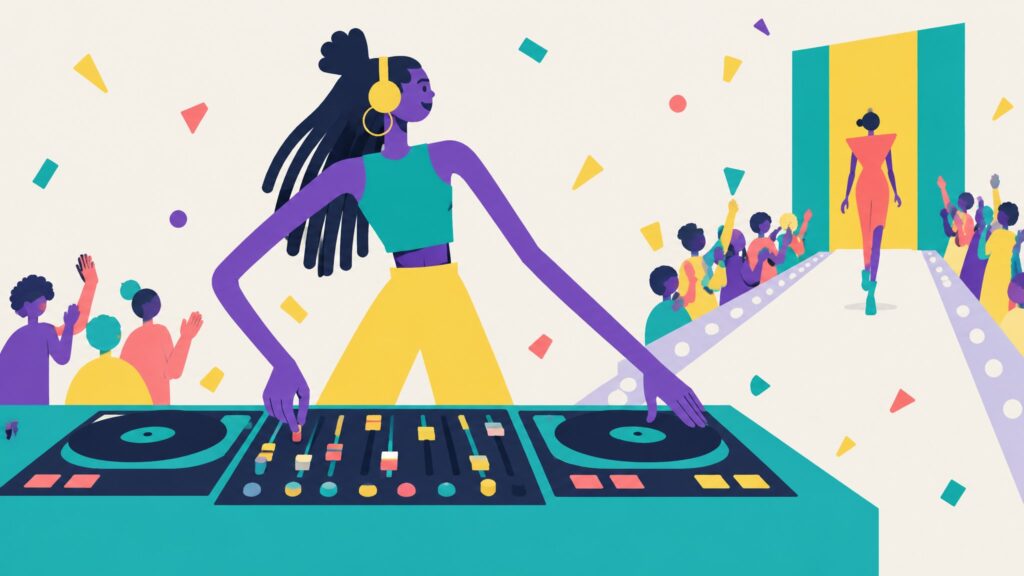
Every runway has four moments that matter to the music: the walk start, the look change, the hold, and the close. Get those right and the show feels designed. Get them wrong and it feels like a party that wandered into a gallery.
I map each one onto your running order before showtime. The music lifts when a walk begins, settles between looks, and drops or sustains through a hold. At the close, it gives the finale room to land.
A preset playlist cannot do this, for a simple reason. Its tracks are fixed lengths on a fixed timeline, and your show is neither. The first delay breaks every cue after it.
The same method scales. One show with twenty looks is one cue sheet. A fashion week day with back-to-back presentations is a stack of them, each with its own mood, its own walk timing and a changeover in between. I treat each presentation as its own show and keep the transitions tight, so one brand’s closing sound doesn’t bleed into the next brand’s first walk. If you’re booking a fashion week DJ in Chicago, ask how the DJ handles changeovers. That’s where generic DJs fall apart.
Run-of-show logic is the same discipline I use for weddings, where the day only works if the moments connect. If you want to see the thinking, here’s a timeline that actually flows.
Building a Cue Sheet From the Running Order
The cue sheet starts with your running order. I take every look in sequence and mark where it begins, where it ends and what the room should feel there.
Then I attach the music decisions. Which section builds. Which look gets a hard drop. Where the sound should thin out so the clothes do the talking. I also mark the safe exits, the points where I can extend or cut without it sounding like a mistake.
Nothing on the sheet is a fixed track list. It’s a map of moments, and I fill each one live from the genres that suit the collection.
Holding, Extending or Cutting a Cue When the Schedule Slips
The schedule will slip. Plan for it.
A walk runs long because a model stops for the photographers. A look gets pulled at the last minute. Hair and makeup push the start by ten minutes. Each of these changes the music, and I handle each live from the shared sheet.
- Hold: I sustain a section, loop an element or ride a drum break until the next walk is actually ready.
- Extend: I stretch the cue so the music stays with a walk that’s running long, without the energy sagging.
- Cut: When a look is pulled, I skip ahead and land the next cue on time.
A preset track just waits to end. I don’t wait. You get music that stays with the show instead of arguing with it.
Working With Producers and Stylists Before Showtime
Most of the work happens before the doors open. By the time the audience is seated, the cue sheet should already be settled, which means the conversation with your production team matters more than anything I do on the night.
I work alongside the producer and the stylist, not around them. They know what the show is. I make sure the sound serves it.
What the Producer and Stylist Hand Over
To build the cue sheet, I need a handful of things from your team:
- The running order, with timing for each segment
- The look sequence, so I know what’s walking when
- Walk timing, including how long each model has on the runway
- Hold points, where the show deliberately pauses
- Any tracks the designer has approved or ruled out
That last item gets overlooked. If the designer hates a certain song, I’d rather know on Tuesday than see it on their face at showtime. If they have approved tracks, I build around them.
From all of that I write the cue sheet and send it back. Your producer signs it off before doors. Once they have, we’re working from the same page, literally.
Rehearsal, Soundcheck and Show-Day Changes
If there’s a rehearsal or soundcheck with the production team, I want to be in it. I’m checking levels in the actual space, hearing how the room carries bass, and running a few cues against real walks. A runway in a ballroom sounds nothing like a runway in a warehouse.
Show-day changes get logged on the shared sheet the moment they happen. A swapped look, a re-ordered segment, a new hold. Then I call them live. The producer doesn’t have to find me and explain. The sheet says what changed, and I’m already moving with it.
This doesn’t replace a producer. I don’t run the show, call the models or manage the backstage. I run the sound, and I need a producer to run everything else.
Choosing Genres That Match a Fashion Brand’s Identity
Genre is a brand decision. The music tells the audience who this designer is before the first look appears.
I mix R&B, hip-hop, house, Afrobeats, Motown and Top 40 live. That’s a wide range, and on a runway it lets the sound follow the collection instead of forcing the collection into one lane. A soft tailored line wants something different from streetwear with attitude.
Two things steer the choice: the collection’s mood and who’s in the seats. A room full of buyers and press reads differently from a room full of friends and fans. I’ll walk your designer through the options so they can sign off on a direction, the same way they’d approve a lookbook. For the method behind it, see choosing genres for a live mix.
Blending R&B, House and Afrobeats Across One Collection
One collection rarely holds one mood. An opening group might be restrained and sleek, the middle louder, the finale a statement.
So I blend. R&B can carry the opening looks with warmth and groove. House takes over as the pace builds, with a steady pulse that gives walks a rhythm to land on. Afrobeats brings lift and swing for a bolder section. Because I mix live, the shifts between them happen inside the show, not between playlists.
You don’t have to choose one genre for the whole night. You do have to choose a direction, and that’s a conversation worth having early.
Pre-Show and After-Party Energy: Keeping the Room Moving
A fashion night has three phases, and each one needs different music. Doors open, the runway, and the after-party. Different tempo, different volume, different job.
My gala work follows the same arc. A seated audience first, then a dance floor once the formal part ends. That’s a runway night too, just with better lighting.
Doors-Open Sets That Let Guests Talk and Still Feel the Room
When guests arrive, they want to talk, find their seats and look at who showed up. The music’s job is to sit under all that and still make the room feel alive.
I keep the volume low enough to talk over. The tempo builds slowly, so by the time the lights drop for the first walk, the room has already warmed up. Nobody notices the build. They just feel the energy lean forward.
It’s the same balance I use at networking events where conversation comes first.
The After-Party Pivot When the Last Walk Ends
The last model leaves the runway. Applause. Then the room has to decide whether it stays.
This is where a live DJ earns the booking. The moment the formal part ends, I lift the tempo and the volume together, and I watch the floor. People who were sitting a minute ago start moving toward the center. If they don’t, I change the record. A playlist won’t notice that.
You can see the same pivot in how a corporate gala moves from dinner into its after-party. Different dress code, same turn.
Pop-Up Shop DJ Sets and Live DJ Work for Retail Events
A pop-up is a runway with no curtain. People wander in, browse, leave, come back. The foot traffic is the show.
The method is the same, at a steadier pace. I keep the sound constant so the space never goes dead during the rush, then lift the energy as the crowd gathers. When it thins out, I ease back. If you’re hunting for a pop-up shop DJ in Chicago, that’s what to ask for: music that tracks the store, not a loop that ignores it.
The same goes for any live DJ for a retail event in Chicago. Product drops, brand activations and open-house nights all depend on a room that feels like something is happening. I’ve covered the launch version in live mixing at brand launch events.
This isn’t a fit if you want a hands-off background loop at a low volume all day. For that, a speaker and a playlist will do the job and cost less.
DJ for a Model Casting Event: Steady Sound for Start-Stop Rooms
A casting call runs in fits and starts. One model walks, the panel talks, the next one steps up. Some minutes it’s packed. Some minutes it’s silent.
Silence is the risk. Dead air makes a room feel awkward, and awkward rooms make nervous models. So I keep a steady bed of sound running underneath, loud enough to carry the room and quiet enough for the panel to talk over.
When the audition pace picks up, I tighten the energy. When it slows, I let the music breathe. If you’re booking a DJ for a model casting event, you need someone watching the pace, not the clock.
Booking a Fashion Show DJ in Chicago: What to Send for a Quote
You can get a quote moving with five details:
- Show date
- Venue
- Running order
- Look count
- End time
Tell me too whether the after-party is included. That one changes the night’s length and the shape of the work, so it affects the quote directly. I’ll confirm exactly what’s covered in the package when we talk, so nothing is assumed.
Those details are what shape the price: the date, the venue, how many looks, how long the night runs and whether I’m playing the party afterward. For a closer look at the logic, here’s what actually drives a DJ’s rate in Chicago. It’s written around weddings, but the drivers carry over.
If you want proof before you commit, my 19 Google reviews are at 5.0 stars, and I’m happy to share audio and video of live sets. Your producer can hear how I mix before you sign anything.
Here’s the ask. Send me your show date, venue, running order and look count, then check open dates on the availability calendar or request a quote. I’ll build the cue sheet from there.
Frequently asked questions
How much does a DJ for a fashion show in Chicago cost?
There’s no flat rate, because the quote depends on the show date, venue, running order, look count and end time. Whether the after-party is included changes it too. Send those details and I’ll quote against your actual night.
Can the same DJ play the runway and the after-party?
Yes. That’s the natural arc: music under conversation at doors, cue-timed mixing for the runway, then a lift in tempo and volume once the last walk ends. Tell me up front if you want the after-party included so the quote covers it.
What if the designer wants certain tracks, or bans others?
Your producer or stylist passes those along with the running order. Approved tracks go into the cue sheet and ruled-out ones stay off it. The designer’s call comes first, and the live mix works around it.
Are you a Chicago DJ, and can I hear your work first?
Yes, I’m Chicago-based and I’ve mixed live since 2023, across ballrooms, rooftop day parties and nightlife rooms. I hold a 5.0-star rating from 19 Google reviews. I can share audio and video samples before you book.