In this article
- Why the Dance Floor Empties: The Real Wedding DJ Mistakes to Avoid
- What "reading the room" actually means at a reception
- Mistake #1: Dead Air Between Songs Kills Momentum
- How live mixing prevents the gap
- Mistake #2: Ignoring Crowd Cues Instead of the Pre-Built Playlist
- Mistake #3: Wrong Genre Pacing Wedding Reception DJs Get Wrong
- Building energy instead of front-loading it
- Mistake #4: Overloading Requests and Losing the Room
- Mistake #5: No Backup Plan for Gear or Genre Curveballs
- Wedding DJ Red Flags to Spot Before You Book
- How to keep wedding guests dancing all night
Every couple worries about the wrong thing when they book a wedding DJ. They ask about song lists. They build genre spreadsheets. They argue over whether “Mr. Brightside” makes the cut.
None of that empties a dance floor. What empties a dance floor is a DJ who can’t adjust in real time. Most wedding reception DJ mistakes to avoid have nothing to do with taste. They’re about pacing, timing, and attention. A great song played at the wrong moment, by a DJ who isn’t watching the room, still clears the floor.
This is a list built from the booth, not from a blog template. Five mistakes. Five fixes. One metric that matters through all of it: is the floor full, or is it emptying.
Why the Dance Floor Empties: The Real Wedding DJ Mistakes to Avoid
Ask any wedding guest why they sat down mid-reception and they’ll shrug. “Just felt like it.” They’re wrong. Something specific pushed them off the floor: a bad transition, a tone-deaf song choice, a DJ who wasn’t paying attention. Guests rarely notice the mechanics. They just feel the room go flat.
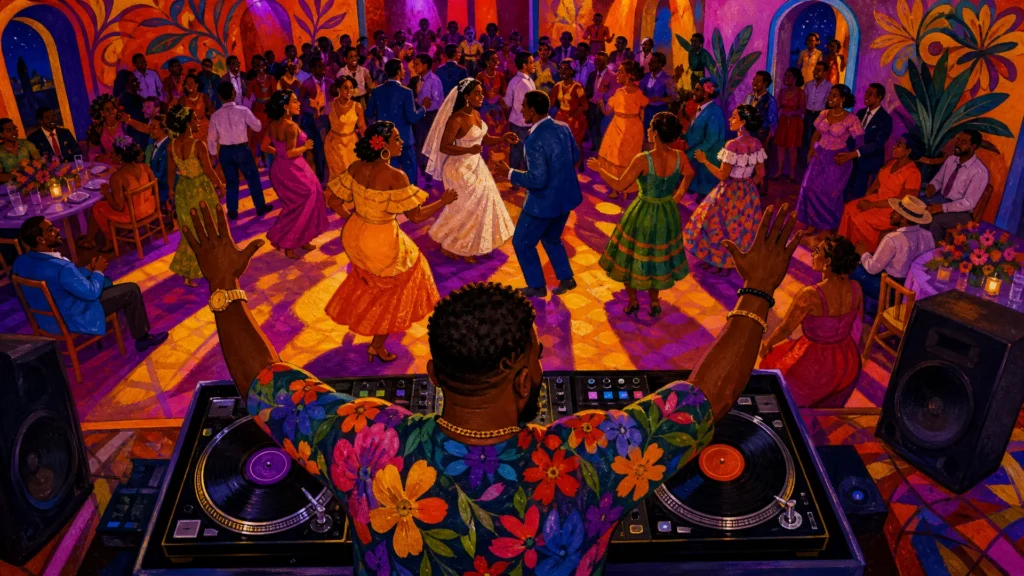
Dance floor energy is the only scoreboard that matters at a reception. Not the setlist. Not the lighting package. Whether bodies are moving at 9pm, 10pm, and 11pm.
What “reading the room” actually means at a reception
Reading the room isn’t a vibe. It’s a skill built on specifics: watching which songs pull people onto the floor within the first 15 seconds, noticing when the crowd skews older or younger than expected, catching the moment energy dips before anyone actually sits down. A DJ who reads the room adjusts the next track, sometimes the next four bars, based on what’s happening right now. A DJ who doesn’t just runs the plan and hopes.
That difference, plan versus response, is where every mistake below starts.
Mistake #1: Dead Air Between Songs Kills Momentum
Here’s the moment: a song ends. Silence, or worse, a clumsy few seconds of fumbling before the next track loads. Guests who were mid-dance stop. Some laugh it off. Most walk to the bar. By the time the next song starts, half the floor has voted with their feet. Off it.
Dead air is a small technical gap with an outsized emotional cost. Momentum on a dance floor is fragile. It takes three good songs to build it and one bad gap to break it.
How live mixing prevents the gap
Beatmatched, live-mixed transitions remove the seam entirely. One track blends into the next at matching tempo. No starting and stopping, no dead air, no reason for feet to stop moving. This is the most direct empty-dance-floor fix there is: never give the crowd a natural exit point.
A DJ working live, adjusting the mix in real time, can also hear the energy sagging a bar early and correct for it. A pre-built playlist, queued track to track, can’t do that.
Mistake #2: Ignoring Crowd Cues Instead of the Pre-Built Playlist
Some DJs show up with the night already decided. A set list, locked in advance, runs top to bottom regardless of who’s actually in the room. That’s a playlist with a human pressing play, not a wedding DJ.
Guests give cues constantly. Which songs get people up. Which get a polite, uninterested nod. Whether the crowd trends toward hip-hop or Motown once they’ve had a drink. A DJ staring at a laptop screen, watching the queue instead of the floor, misses every one of those signals. A DJ watching feet and faces catches them and adjusts the next song accordingly.
This is really the whole argument for live mixing versus a preset playlist DJ: one approach can respond to a room in real time, the other can’t respond at all. For the deeper mechanics, there’s a full explainer on what it actually means for a DJ to read the crowd.
Mistake #3: Wrong Genre Pacing Wedding Reception DJs Get Wrong
Pacing mistakes are quieter than dead air, but they cost just as much. The most common one: front-loading peak-energy songs during cocktail hour. The DJ plays the biggest bangers early, guests get excited, and then there’s nowhere left to go for the last hour of dancing. Energy that should climb toward the last song flatlines by 9:30 instead.
The opposite mistake happens too. A DJ never builds past cocktail-hour energy at all, keeping everything at the same polite mid-tempo through dinner and into the dance set. The room never gets the payoff it’s waiting for.
Building energy instead of front-loading it
Good pacing looks like a slow, deliberate climb: warm and easy during cocktail hour, a little more tempo through dinner, then a real build once the dance floor opens. Save the highest-energy songs for when the crowd is primed to use them. That build only works if the DJ reads the room live and adjusts the climb to match how fast, or slow, this particular crowd is warming up. Not by running a fixed order regardless of what’s happening at 8:45.
Mistake #4: Overloading Requests and Losing the Room
Every reception has requests. Grandma wants a big band standard. A cousin wants a niche genre track nobody else knows. The bride’s college roommate has three songs she’s been saving up. A DJ who says yes to all of it, in the order it comes in, turns the night into a disjointed jukebox with no flow.
Requests aren’t the enemy. Blind compliance is. An experienced DJ filters requests against what’s actually working on the floor: holding a good one for the right moment, gently skipping one that would kill momentum, blending a request into the set instead of just bolting it on. That judgment call, made live and in the moment, is exactly what keeps a floor full while everyone still feels heard.
Mistake #5: No Backup Plan for Gear or Genre Curveballs
Technical failures happen. A wireless mic cuts out mid-toast. A laptop freezes. A cable fails. What separates a professional from a risk is whether a backup rig is ready to go in seconds, or whether the DJ is scrambling in silence while 150 guests watch.
The same logic applies to genre curveballs. Sometimes a crowd skews harder toward Afrobeats, or house, or old-school Motown than anyone predicted going in. A DJ locked into one narrow lane has nothing to offer that crowd. A DJ who can mix across R&B, hip-hop, house, Afrobeats, Motown, and Top 40 live, based on what the room actually wants, can pivot without missing a beat. This range, and the prep behind it, is one of the clearest wedding DJ red flags to check for before you book. Ask what happens if gear fails. Ask what happens if the crowd doesn’t match the plan.
Wedding DJ Red Flags to Spot Before You Book
Most of the mistakes above stay invisible until the night of the wedding, unless you know what to ask beforehand. A short consult conversation will surface almost all of it.
Watch for these signs during a consult:
- They can’t describe how they’d handle a dead dance floor mid-reception, only that it “won’t happen.”
- They talk exclusively about their playlist or song list, never about reading a live crowd.
- They can’t explain their pacing plan from cocktail hour to last dance.
- They have no clear policy on handling guest requests without losing flow.
- They don’t mention backup gear, or dodge the question entirely.
None of these are dealbreakers on their own. Together, they’re a pattern. For a longer list of questions to ask before hiring a wedding DJ, and a rundown of what to look for in top Chicago wedding DJs, read them before your first consult, not after you’ve already signed a contract.
How to keep wedding guests dancing all night
The short version: no dead air, a DJ watching the room instead of a screen, a deliberate build from cocktail hour to last dance, smart request handling, and a real backup plan. That’s the whole list. It sounds simple. Very few DJs actually pull off all five at once.
DJ KMBRK mixes R&B, hip-hop, house, Afrobeats, Motown, and Top 40 live in real time, based on how the room responds, not from a pre-built playlist. Couples across Chicago weddings, corporate events, and nightlife bookings have given KMBRK a 5.0-star rating across 19 Google reviews. Read why KMBRK holds a 5.0-star rating straight from the couples who booked it.
If you’re planning a Chicago wedding and you’d rather not gamble on dead air, a fixed playlist, or a DJ with no backup plan, talk to someone before you sign anything. Book a live-mixing wedding DJ in Chicago and walk through your reception timeline on a call. The dance floor will thank you at 9:40pm.