
In this article
- Why a Lake Michigan Boat Party Is Its Own Kind of Room
- Matching a DJ to Your Chicago Boat Party Format
- Reading an Open-Air Crowd That Never Holds Still
- Where the Energy Goes When the Deck Moves
- Pacing the Set From Sunset to After Dark
- Setting Up Sound in a Tight, Open-Air Space
- Speaker Placement and Coverage on a Narrow Deck
- Setting Levels for Wind and Open Water
- Equipment Logistics on a Boat: Power, Load-In, and Securing Gear
- Load-In and the Captain's Sign-Off
- Building a Nightlife Genre Mix That Works on the Water
- Warm-Up Picks for Guests Still Boarding
- Peak-Hour Calls: Hip-Hop, House, and Afrobeats
- Booking a Boat Party DJ in Chicago: What to Confirm and Send
- What to Send With Your Quote Request
- Frequently asked questions
- How loud can a DJ run the music on a Chicago boat party?
- What power does a DJ need on a boat?
- Who decides where the DJ sets up on a chartered vessel?
- What music works for a mixed crowd on the water?
- What should I send when I request a quote for a 2027 boat party?
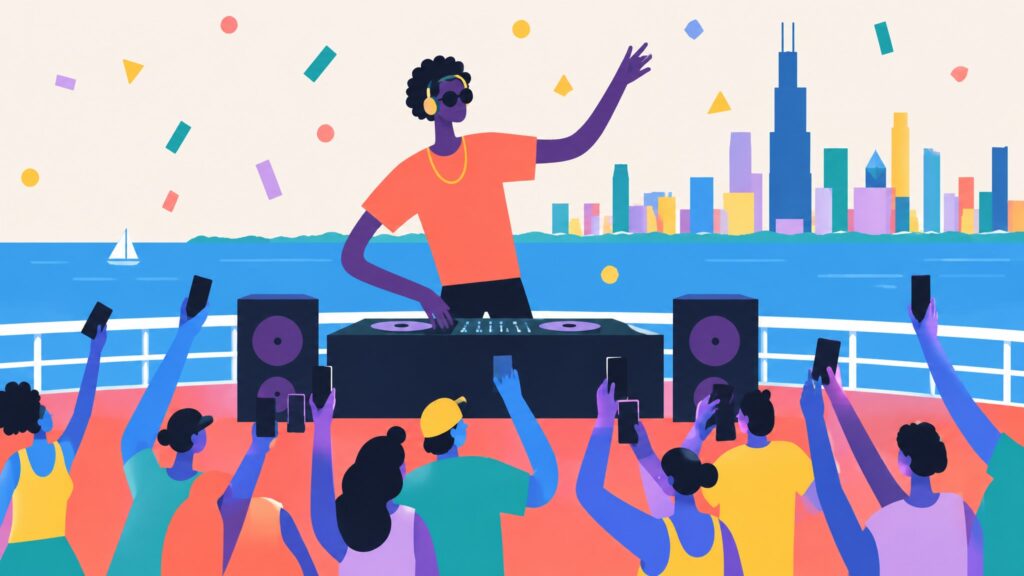
The boat clears the harbor. The skyline swings into view. Every phone on deck comes up at once.
That’s the first minute of any night on the water, and it tells me what I need to know about the crowd. As a Lake Michigan boat party DJ, I don’t get a room with walls. I get a deck, a horizon and a few hundred feet of open air that doesn’t care about my plan.
I’ve been behind the decks in Chicago since 2023, and I mix live. No pre-built playlist, no autopilot. This guide covers the craft side of a boat set: how the crowd moves, how sound behaves over water, and what to lock down before the date.
Why a Lake Michigan Boat Party Is Its Own Kind of Room
A ballroom holds sound in. A rooftop lets some of it escape. A boat lets the wind take it, and your guests can’t leave when the energy dips.
That changes the job. Guests are on the vessel until it docks, so a flat stretch of music has nowhere to hide. There’s no smoking patio to drain the floor and no second room to wander into. Everyone is in the same shared space for the whole cruise, and the set has to carry all of them.
Some things don’t change. A crowd still tells you what it wants within the first few songs. Familiar hooks still pull people together. Smooth transitions still matter more than flashy ones. My venue history runs from ballrooms to rooftop day parties to nightlife rooms across Chicago, and that experience carries over to a deck because the core skill is the same: watch the people, then move the music.
A playlist can’t read a room. It definitely can’t read a moving one.
Matching a DJ to Your Chicago Boat Party Format
“Boat party” covers three very different nights. The format sets the crowd’s expectations, and it sets how loud the set can run.
Private yacht charter. If you’re hiring a DJ for a private yacht in Chicago, you know most of the guests. A wedding party, a birthday, a milestone. The crowd wants a soundtrack that suits the group, so the set often starts conversational and builds. Volume stays moderate early because people are talking, toasting and taking photos. A yacht party DJ in Chicago earns the louder hour later, once the group is loose.
Public booze cruise. This is strangers who bought tickets and came to dance. Expectations are higher from the first boarding call, and the set leans into familiar, high-energy picks sooner. A Chicago booze cruise DJ can run louder, but the operator still sets the ceiling, and a packed public deck means the sound has to stay clear without being brutal.
Corporate sail. Colleagues, clients, a few people who’d rather talk than dance. The music works as atmosphere first, with announcements and toasts built in. If you’re weighing a sail against a land-based option, our notes on corporate summer party planning cover the comparison. On a corporate sail, I keep the level low enough for conversation and raise it only if the group leans in.
Each format has a different ceiling. Tell me which one you’re booking, because the same song list played at the wrong volume ruins all three.
Reading an Open-Air Crowd That Never Holds Still
A ballroom floor has a center. A boat doesn’t. Guests drift between bow, stern, rail and bar, and the cluster you see at 8pm is gone by 8:20.
My job is to watch where the deck packs in and adjust. If a dense group has formed near the stern, I’m listening to what they respond to. If the bow is thin and the rail is full of people taking in the skyline, that tells me something too. A playlist plays the same track to all of them regardless.
Where the Energy Goes When the Deck Moves
Guests follow three things on a boat: the view, the bar and the beat. The view pulls people to the rail. The bar pulls them toward a fixed spot. Only the music can pull them toward the middle.
So I read the deck in zones. A packed bar line means people are waiting, which is a good moment for something familiar they can nod along to. A crowded rail with few dancers means I ease off and let the scene do the work. A group at the stern bouncing before I’ve asked them to is a signal to lift tempo and level together.
The same instincts apply anywhere people move around a space while the party runs. I wrote up how the same crowd-reading approach works on a rooftop bar, and the boat version is the same craft with less room to hide.
One caution for you: a live read can’t fix a deck that’s overpacked or a layout that leaves the dance space the size of a closet. I work with what the vessel gives me.
Pacing the Set From Sunset to After Dark
Picture a typical summer cruise. The boat pulls out in full daylight. Guests are holding drinks, taking pictures, finding their people. The sun drops toward the skyline, and everything goes gold for about twenty minutes.
That’s not the moment for a hard drop. It’s the moment for songs people can sing along with while they’re looking at the view.
Then the light goes. The skyline flips from postcard to glow, the deck gets a little louder on its own, and the crowd’s inhibition drops with it. That’s when I start pushing. Tempo creeps up. The low end gets heavier. The people who were at the rail drift in.
I use the same daylight-to-dusk logic in live mixing from brunch to dusk. On the water, the shift just happens faster because the whole boat watches it together.
Setting Up Sound in a Tight, Open-Air Space
Sound carries farther over open water than people expect. Wind pushes it around too. A level that feels right at the DJ table can travel well past the people on deck, and that’s a problem for you if the operator, the neighbors on shore or other boats start noticing.
Speaker Placement and Coverage on a Narrow Deck
A narrow deck is a long, thin listening space. Point speakers badly and one end gets blasted while the other hears mush.
The goal is even coverage with the least level. I aim speakers along the length of the deck rather than out over the water, so the sound lands on people and not on the lake. The rail and the stern hear the set differently: the rail often sits closer to the speakers and gets more direct sound, while the stern can lose clarity as the wind catches it. I listen from those spots, not just from behind the table.
Some of this is mine to control: speaker angle, how the system is balanced, how I walk the deck during sound check. Some of it isn’t. Where speakers can physically sit, and whether stands can be used at all, is the operator’s call.
Setting Levels for Wind and Open Water
Wind eats highs and shifts the sound from one side of the deck to the other. I set levels by walking the boat, not by trusting the meter at the table.
If I’m running a long set, I’ll adjust throughout. A breeze that picks up after dark can change what the stern hears in minutes. I’d rather ride the level up and down than set it once and hope.
Louder isn’t better here. Clear is better. A set that’s clean at moderate volume gets people dancing. A set that’s loud and muddy sends them to the bar.
Equipment Logistics on a Boat: Power, Load-In, and Securing Gear
Boats don’t forgive improvisation. You can’t run to the van for a missing cable once the lines are cast off, so everything gets confirmed before the date.
Power comes first. Find out whether the vessel offers shore power, a generator or neither. If clean power isn’t available, a self-contained battery setup is the fallback, and that needs planning well ahead. Dirty power can mean hum in the system, so it’s not a detail to guess at.
Then secure everything. When the hull moves, anything loose slides. I strap cases and stands, keep the heavy gear low, and route cables off walkways so nobody trips. Guests are moving around with drinks, and a cable across the deck is a liability.
Plan the carry. The path from the lot to the gangway is part of the job. Know the distance, the surface and whether a cart can get through.
Load-In and the Captain’s Sign-Off
On a chartered vessel the operator usually has the final say on power, sound and where equipment can sit. The captain has the final say on the boat itself. That’s why these details get agreed before load-in, not on the dock with guests lining up behind you.
Ask the operator for the load-in window and the setup spot, and confirm them in writing. If the window is tight, it affects how much setup time the booking needs, which is the same logic behind what drives a Chicago DJ’s hourly rate. Setup time is real time, and a boat compresses it.
Building a Nightlife Genre Mix That Works on the Water
A nightlife DJ on a boat has to cover a lot of ground. A mixed crowd on a mixed deck wants several styles in one night, and nobody’s tolerance for a bad run of songs is high when they can’t leave.
My live range covers R&B, hip-hop, house, Afrobeats, Motown and Top 40, all in the same night. The order isn’t fixed. It’s set by how the crowd responds, and on a boat that response is easy to see because everyone is in view.
Warm-Up Picks for Guests Still Boarding
Boarding is slow. People are finding spots, grabbing a first drink, saying hello. Motown and R&B work here because they’re warm, familiar and easy on the ears at a lower level.
Top 40 comes in when I hear singing or see heads bobbing. Familiar hooks are the quickest way to turn a collection of strangers into a group. I don’t commit to a direction until I see who responds.
Peak-Hour Calls: Hip-Hop, House, and Afrobeats
Once the deck is full and the light is gone, the set can open up. Take a typical night: the stern is packed, people are dancing near the speakers, and the crowd keeps reaching for the same kind of groove. That’s my cue to move from Top 40 into hip-hop, then let house or Afrobeats carry the floor if the energy holds.
If a hip-hop run thins the dance area, I don’t push it. I pivot to something the whole deck knows. The switch follows the people, never a preset order.
This isn’t the set for someone who wants a strict, pre-approved list played in sequence. If your guest of honor needs an exact running order, say so up front and we’ll plan around it.
Booking a Boat Party DJ in Chicago: What to Confirm and Send
Dates fill up, and a boat season is short. Starting your 2027 conversation now leaves the most choice, so plan to move early.
Before you request a quote, confirm these with the operator:
- Departure area and boarding time
- Cruise length
- Headcount
- Public or private format
- Power and sound rules
- Who runs the bar
Those six answers shape the gear, the setup time and the way I’ll pace the night. If you’re also comparing options for a non-boat event, a broader guide to hiring a DJ for a private event covers the basics.
My proof is public. DJ KMBRK holds a 5.0-star rating across 19 Google reviews, so you can read what past clients said before you commit to a date.
What to Send With Your Quote Request
Keep it short. Send me the date, the departure area, the cruise length, the headcount and the format. Add anything the operator has told you about power, sound limits or load-in.
The sequence is simple. Check DJ KMBRK’s open dates, send the details, request the quote.
Frequently asked questions
How loud can a DJ run the music on a Chicago boat party?
It depends on the format and on the operator, who sets the ceiling. A corporate sail stays low enough for conversation, a private charter builds through the night, and a public booze cruise can run loudest. Sound carries farther over open water, so the goal is clear sound at a moderate level, not maximum volume.
What power does a DJ need on a boat?
The DJ needs clean power, so confirm with the operator whether the vessel has shore power, a generator or neither. If clean power isn’t available, a self-contained battery setup is the fallback and needs planning before the date. Ask about this early, not on the dock.
Who decides where the DJ sets up on a chartered vessel?
The operator, and usually the captain, has the final say on power, sound and where gear can sit. Agree the load-in window and setup spot with them before the date. The DJ controls speaker angle, balance and levels within those limits.
What music works for a mixed crowd on the water?
A blend that moves with the crowd. Motown and R&B suit boarding, Top 40 brings familiar hooks, and hip-hop, house and Afrobeats carry the peak after dark. The order follows how guests respond, not a fixed list.
What should I send when I request a quote for a 2027 boat party?
Send the date, departure area, cruise length, headcount and format (private yacht, public cruise or corporate sail). Add any power, sound or load-in rules from the operator. Checking the availability calendar first saves a round of emails.