
In this article
- A Quinceañera Floor Holds Three Generations at Once
- Why a Chicago Quinceañera DJ Has to Read the Room
- Watching Teens, Parents and Abuelos at Once
- Why a Playlist Stalls When the Room Splits
- Genre Blending in Real Time Across Every Age in the Room
- Motown and Top 40 as the Bridge Between Generations
- R&B and Hip-Hop Inside a Chicago Top 40 Set
- Court Dance and Surprise Dance Coordination
- DJ for Court Dance: Cues, Timing and the Vals
- Cueing the Surprise Dance Without Losing the Floor
- Locking the Run Sheet, Song List and Announcements Before the Night
- Proof From Past Floors: Reviews and Live Video
- 19 Google Reviews, Read Closely
- What Shapes a Quinceañera DJ Quote in Chicago
- Frequently asked questions
- Can one DJ keep teens and grandparents dancing at the same quinceañera?
- Who handles the court dance and surprise dance cues?
- What should I send before the pre-event call?
- Why ask for an itemized DJ quote?
- How do I check if you're free on my date?
It’s 9:40pm. The court dance is over, the cake is cut, and the floor has a problem.
The birthday girl’s friends are ready to go. The tías are halfway out of their chairs. The abuelos are watching from the tables, hands folded, waiting to see if this night has a song for them.
That moment decides whether you hired a DJ for a quinceañera in Chicago or just rented a speaker. I’m DJ KMBRK, and this page explains how I handle it.
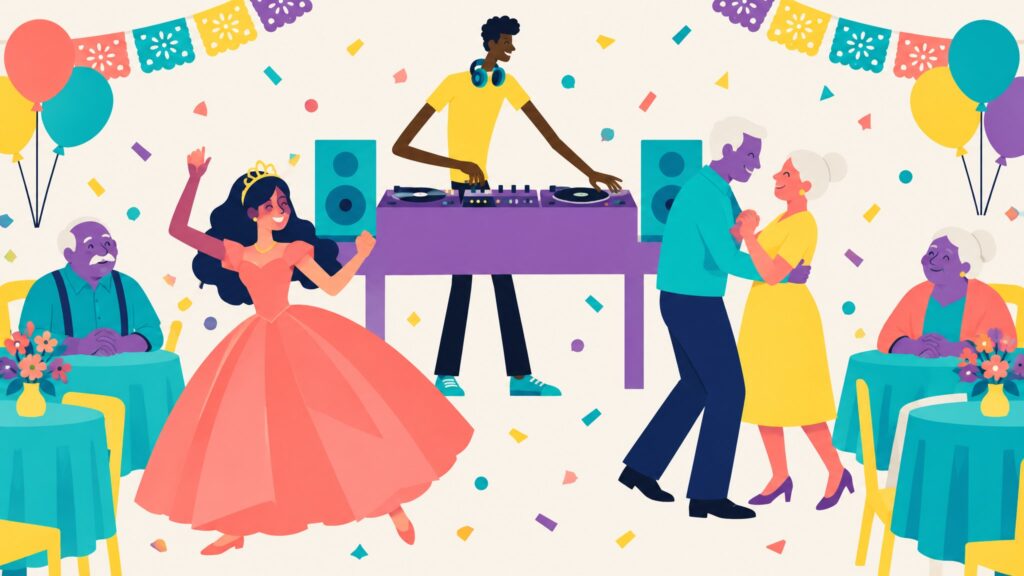
A Quinceañera Floor Holds Three Generations at Once
Nobody sits down at a good quinceañera. That’s the goal, and it’s harder than it sounds.
Three groups share one room, and they want different things.
The birthday girl and her friends want songs they know every word to. They’ll scream a chorus before the second verse lands.
The parents want to dance, but they want songs from their own years, and they want to see their daughter happy more than they want to be on the floor.
The abuelos want to feel the night belongs to them too. A song from their era does more for them than any speech.
A playlist picks one of those groups and hopes for the best, while a live DJ watches all three and moves between them as the night changes, which is the only way to keep a room that wide on its feet from the first dance to the last song.
Why a Chicago Quinceañera DJ Has to Read the Room
A playlist is built before the room exists. Someone guesses what 150 people will want, locks the order, and presses play.
A playlist can’t read a room.
Watching Teens, Parents and Abuelos at Once
I work the floor with my eyes up, not on a laptop. At any moment I’m counting three things: who is dancing, who is standing at the edge deciding, and who hasn’t moved since dinner.
Say the teens are packed in front of the booth and the older guests are seated. I don’t drag the whole room toward the teens. I stay in the lane the teens love, then drop one song the parents know cold. When the parents get up, I hold that energy a few songs and listen for the abuelos to start clapping along.
That’s the read. The next song comes from what the floor just told me.
The same skill applies to other mixed-age rooms. My Sweet 16 live-mixing guide covers the teen half of the floor, and mixed-age bar mitzvah floors show the same split between kids, parents and grandparents.
Why a Playlist Stalls When the Room Splits
Here’s how a pre-built set fails. At 8:30 the teens want one sound and the older guests want another. The playlist doesn’t know that. It plays song 41 because song 41 is next.
The teens drift to their phones. The older guests stay seated because nothing has been aimed at them. Within ten minutes you have a dance floor with a dozen people on it and a room full of people being polite.
A live DJ sees the dip in the first thirty seconds. Then he changes the song, the tempo or the genre, and the floor tells him if it worked.
You pay for that judgment. You don’t pay for a list.
Genre Blending in Real Time Across Every Age in the Room
My live set draws on R&B, hip-hop, house, Afrobeats, Motown and Top 40. I mix them in real time from how the crowd responds, so the order of the night belongs to the room, not to a spreadsheet. If you want the planning logic behind it, here is how genres get chosen for a mixed crowd.
The trick is the bridge. Blending doesn’t mean playing a little of everything. It means choosing the track that lets one generation walk into the next generation’s music without a hard stop.
Motown and Top 40 as the Bridge Between Generations
Motown is the abuelos’ song, or close enough to it. When a Motown groove comes on, grandparents who’ve been seated for an hour often start moving their shoulders before they realize it.
Top 40 sits in the middle. Parents know it from the radio, and teens know it from everywhere. A current pop song that borrows a classic groove can carry an older guest into the younger part of the set, and the floor never notices the handoff.
I don’t announce these moves. I just run them: Motown to a soul-heavy Top 40 record, then a pop hit the teens scream for. Nobody gets dropped.
R&B and Hip-Hop Inside a Chicago Top 40 Set
R&B is the second bridge. It’s smooth enough for parents and current enough for the teens, so it keeps the middle of the room dancing while the energy builds.
Hip-hop is where the teens take over. When their half of the floor is full and loud, I open up hip-hop and let the younger crowd have a run. If the abuelos start to fade, I pull back to R&B or Motown before the room splits again.
One limit worth stating plainly. Live mixing isn’t a promise to play one genre all night, and it isn’t for a family that wants a fixed order of songs with zero changes. If you want that, a playlist will serve you better.
Court Dance and Surprise Dance Coordination
A traditional quinceañera program moves in a set order: court entrance, the vals, the surprise dance, then the open floor. I know that run, and I treat it like a show with cues, not a stretch of background music. For the timing logic behind it, see how to build a running order that flows.
Here’s the division of labor. I own timing and transitions. The court and the family own the choreography.
DJ for Court Dance: Cues, Timing and the Vals
Court entrance is a cue sequence. Each pair walks in on a song or a section of one, so I need to know when the first pair steps out and when the last one lands. That goes on the run sheet before the night.
The vals is the most exposed moment. If the track starts a beat late or the volume sits wrong, everyone feels it. I confirm the exact version of the song with the family, the start point and any edit, so the cue is the same on the night as in rehearsal.
If your court has been practicing to a rehearsal track, send it to me. The closer my files match what your dancers have rehearsed to, the fewer surprises you get under the lights.
Cueing the Surprise Dance Without Losing the Floor
The surprise dance is a hard turn. The room has just watched something formal, and now the music changes and the teens take the floor.
I plan that turn with the family, because the song choices are theirs. Then I watch the room on the night. If the crowd is still settling, I hold the track a moment. If they’re already leaning in, I go.
The handoff to the person with the microphone matters too. Whoever announces each name needs a clear cue from me, and I need to know when they’re done. That’s decided before the night, not improvised with 150 guests watching.
When the surprise dance ends, the open floor begins, and that’s where the live read takes over again.
Locking the Run Sheet, Song List and Announcements Before the Night
I hold a pre-event call with the family. If you want a better night, this is the call that matters most.
On that call we lock four things:
- The run sheet, with every cue in order from court entrance to last song.
- The must-play list, including songs the family wants in any language.
- The do-not-play list, so nothing lands that shouldn’t.
- Who speaks when, and who holds the microphone for each announcement.
Every name on the do-not-play list is a name I’ll honor. Every must-play I’ll place where the room can use it, which isn’t always the moment you imagined. I’ll tell you that on the call, not on the night.
If you’re comparing DJs, take these questions to ask before you book into every conversation. A DJ who can’t tell you how the court cues will work shouldn’t be running them.
Proof From Past Floors: Reviews and Live Video
You shouldn’t book a DJ on a promise. Look at what they’ve done.
I’ve been behind the decks since 2023, working ballrooms, rooftop day parties and nightlife rooms across Chicago. Those floors are very different, and the read-the-room method has run on all of them.
The live-set video is labeled by room: ballroom, rooftop or nightlife footage. It isn’t quinceañera footage, and I won’t present it as that. What it shows is how I handle a floor as it fills, stalls and surges.
19 Google Reviews, Read Closely
DJ KMBRK holds a 5.0-star rating across 19 Google reviews. The count is small and the rating is perfect, so don’t stop at the stars.
Open the reviews and read for what they describe. Look for the room, the floor and how the night moved, because those are the details a playlist can’t earn. Then compare that to what any other DJ on your shortlist can show you.
What Shapes a Quinceañera DJ Quote in Chicago
A quote isn’t a single number pulled from the air. It’s built from parts, and you can ask to see them.
Hours on the floor. A longer night means more time reading the room and more set to build.
Court and rehearsal time. Cueing a court entrance, a vals and a surprise dance takes prep that a standard dance night doesn’t need.
Announcements. If I’m running the microphone through the program, that’s work on top of the music.
Equipment. The room size, the sound needs and the setup all change what I bring.
Venue travel. Getting to a ballroom downtown is a different job than loading into a rooftop across the city.
Ask for an itemized quote from every DJ you consider. A line-by-line breakdown is easier to compare than one flat figure, and it shows you what you’re paying for. For the wider picture of hiring for any family or corporate occasion, my private event DJ guide covers it.
Ready to move? Check open dates on the availability calendar first, because good Saturdays go early.
Then send an inquiry with your event date, venue, guest count, and the songs for the court dance and the surprise dance. That’s enough for me to start building your run sheet.
Frequently asked questions
Can one DJ keep teens and grandparents dancing at the same quinceañera?
Yes, if the DJ reads the floor and doesn’t follow a fixed playlist. I watch who is dancing and who is seated, then use bridge tracks from Motown, Top 40 and R&B to move one group into the next group’s music. Nobody gets dropped, and nobody waits an hour for their song.
Who handles the court dance and surprise dance cues?
I handle timing and transitions: the song start points, the cues and the handoff to whoever holds the microphone. Your family and court own the choreography. We confirm all of it on a run sheet before the night.
What should I send before the pre-event call?
Send your event date, venue, guest count and the songs for the court dance and the surprise dance. If your court has a rehearsal track, send that too. On the call we add your must-play list and do-not-play list.
Why ask for an itemized DJ quote?
A quinceañera quote depends on hours on the floor, court and rehearsal time, announcements, equipment and venue travel. A line-by-line quote shows what each part costs, so you can compare DJs fairly. A single flat number hides what’s included.
How do I check if you’re free on my date?
Check the Chicago DJ availability calendar first. If your date is open, send an inquiry with your venue and guest count so we can start on the run sheet.