In this article
- Why DIY Wedding Playlists Fail After Dinner
- The Dead Air Problem at 9:40 PM
- Algorithms Can't Read a Chicago Crowd
- Live Mixing vs. Playlist Apps: The Real Difference
- Real-Time Transitions Keep Floors Packed
- Genre Blending That Apps Cannot Replicate
- Reading the Room: A Skill, Not a Buzzword
- What 'Reading the Room' Actually Looks Like in Practice
- Proof Over Promises: Video Evidence of Live Performance
- Watch Real Sets, Not Highlight Reels
- Venue-Specific Energy Examples
- Cost Reality: Budget DJs vs. Professional Live Mixers
- Vetting Your Alternative: Questions That Expose Playlist DJs
- Ask for Unedited Set Recordings
- Confirm Genre Range Beyond Top 40
- Secure a DJ Who Mixes Live for Your 2026 or 2027 Wedding
You went looking for an alternative to a Spotify playlist DJ because you suspect an app can’t manage a live crowd. Trust that instinct.
A pre-built queue can’t read the room. No algorithm can save a dance floor when the mood shifts mid-song. Hiring a real DJ instead of an app isn’t about having a body behind the booth. It’s about having someone who builds the night’s momentum in real time.
Why DIY Wedding Playlists Fail After Dinner
The ceremony ends, dinner wraps, and that’s when a static music plan shows its cracks. Guests are ready to move. The playlist just keeps playing whatever got queued up hours ago, blind to what’s actually happening in the room. Excitement drains fast when the music stops matching the moment.
The Dead Air Problem at 9:40 PM
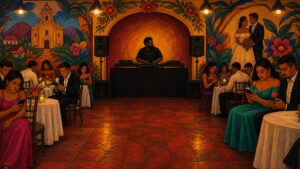
Silence kills momentum faster than any bad song choice. A pre-set playlist hits a tempo mismatch or a clumsy transition during peak dancing hours, and the floor clears instantly. Nobody’s there to bridge the gap. You watch guests check their phones and drift back to their tables while the system fumbles a crossfade a real mixer would have smoothed over. This is exactly why couples end up hunting for wedding music alternatives to Spotify, usually after watching it go wrong at someone else’s reception first.
Algorithms Can’t Read a Chicago Crowd
Software predicts patterns from data. It can’t feel the room. A Chicago crowd responds to cultural cues and regional favorites that global streaming metrics don’t track at all. Live mixing adjusts to those micro-shifts as they happen. Weigh a DIY wedding playlist against a live DJ setup and you’re left hoping the algorithm guessed right for your specific mix of family and friends. The difference between a packed floor and an empty one usually comes down to whether someone’s watching the people or just watching a screen.
Live Mixing vs. Playlist Apps: The Real Difference
Automated playback treats music as a sequence of files. Live performance treats it as a conversation with the audience. You deserve more than a shuffle function when the stakes are this high and the memory is permanent. Knowing the technical difference helps you dodge common wedding DJ mistakes that come from confusing “has access to songs” with “can perform.”
Real-Time Transitions Keep Floors Packed
Seamless blending takes active listening and manual adjustment, and no software replicates that. A live mixer matches beats, adjusts EQ, and times transitions off how the crowd is moving right now, not off a waveform analysis done in advance. That’s the real gap between live mixing and playlist playback at weddings: no audible gaps, no clashing keys, no broken immersion. For the deeper technical rundown, there’s a live mixing versus playlist DJ breakdown laying out exactly where automation falls apart.
Genre Blending That Apps Cannot Replicate
Moving from Motown into modern Afrobeats takes harmonic knowledge and a willingness to take a creative risk, and that’s not something binary code can do. I blend R&B into house, or push Top 40 into hip-hop, by finding the musical connection underneath, not just matching metadata tags. I’ve been behind the decks since 2023, with performances spanning R&B, hip-hop, house, Afrobeats, Motown, and Top 40, and I make these genre shifts by hand to keep a mixed crowd on the floor. An app sees two categories. A live mixer hears a bridge between generations.
Reading the Room: A Skill, Not a Buzzword
Every vendor claims they read the room. Few can tell you what that actually looks like under pressure. It’s not a vibe or a marketing line. It’s a series of specific adjustments made in response to what the crowd is doing right now. If your DJ can’t walk you through that process, they probably don’t have one.
What ‘Reading the Room’ Actually Looks Like in Practice
I drop the BPM when guests sit down en masse. I switch genres the moment a specific group hits the floor. I’ve built this against ballrooms, rooftop day parties, and nightlife rooms across Chicago, where reading the crowd means responding to what people’s bodies are doing, not guessing. You need someone who knows that what worked at last month’s wedding might completely miss at yours. Live mixing across ballrooms, rooftop day parties, and nightlife venues around the city is what makes that adaptability real instead of a talking point.
Proof Over Promises: Video Evidence of Live Performance
Testimonials are subjective. Video isn’t. Demand verification before you sign anything, because claiming you mix live is easy and faking it on camera is hard. Trust comes from what you can see, not from copy on a website.
Watch Real Sets, Not Highlight Reels
Highlight reels hide the moments where a DJ struggles or loses the room. Unedited clips show you the truth: transition quality, crowd engagement, how someone recovers when something goes sideways. Verify technical ability with real footage, not a star rating alone. Unedited wedding set recordings give you a look at the actual standard, not the edited version of it.
Venue-Specific Energy Examples
Energy in a hotel ballroom doesn’t look like energy at a rooftop day party or in a tight nightclub room. Watching a DJ perform in Chicago venues you recognize tells you they understand the acoustics and the crowd expectations this city actually has. DJ KMBRK holds a 5.0-star rating across 19 Google reviews from Chicago wedding and event clients, which is what showing up consistently across different rooms earns you. A generic clip from an unnamed venue tells you nothing about how someone handles your room.
Cost Reality: Budget DJs vs. Professional Live Mixers
Price reflects experience and risk. A budget rate often subsidizes inexperience, and that gets expensive fast once the reception stalls, because no refund brings back a dead dance floor. You’re paying for insurance against silence as much as you’re paying for music.
A clear rate structure reflects real experience and real equipment, without hidden upsells. Professional live mixing heads off the most volatile part of your event before it becomes a problem. Cheap entertainment turns into the most expensive line item on your invoice the moment you’re stretching the open bar or rushing the timeline to cover for dead air. Paying for a skilled operator protects the return on everything else you spent on the day.
Vetting Your Alternative: Questions That Expose Playlist DJs
The right questions separate a real performer from someone running a playlist. Vague answers mean they’re leaning on automation. Detailed answers mean they know their craft. Use these before you waste a consultation on someone who isn’t a fit.
Ask for Unedited Set Recordings
Ask for full-length audio or video from a recent wedding, not a curated clip for social media. A real live mixer has hours of documented sets showing they can hold the energy, not just spike it once. Hesitation, or excuses about privacy, usually means there isn’t much footage to show. The evidence that actually proves someone mixes live is raw, unedited footage, not a handful of cherry-picked moments.
Confirm Genre Range Beyond Top 40
Ask how they handle requests that fall outside the mainstream charts. Real versatility takes deep library knowledge and mixing technique that goes well past a trending playlist. Ask about the specific artists or subgenres tied to your family’s background or your own taste. If they can’t talk about that with any confidence, they’re probably leaning on algorithmic suggestions to fill the gap.
Secure a DJ Who Mixes Live for Your 2026 or 2027 Wedding
Top live DJs book 12 to 18 months out for peak 2026 and 2027 Chicago seasons. Wait until the final months and you’re choosing from whoever’s left, not who actually fits your wedding. Booking early locks in the date and gives you time to vet properly.
Start the conversation expecting to review live set videos and talk through the specific sound you want for your day. Look at Chicago wedding DJ services to start from demonstrated ability instead of a sales pitch. What reading the crowd actually means is worth understanding before that conversation, so you know what to ask for. Your wedding deserves a soundtrack built in the moment, not downloaded the night before.