In this article
- The 9:40pm Wall: When Preset Sets Fail
- Identifying the exact moment energy dies
- Why pre-planned transitions ignore room temperature
- Crowd Signal Mechanics vs. Static Playlists
- Reading micro-movements before the floor clears
- Genre pivots that save momentum
- Preset DJ Setlist Issues That Drain Energy
- The Psychology of Predictable Transitions
- Real-Time Mixing as Crowd Insurance
- Blending tracks to maintain subconscious flow
- Adapting to venue acoustics and layout changes
- Playlist DJ Problems Specific to Chicago Events
- Vetting for Live Skill Over Song Libraries
- Questions that expose read-the-room ability
- Proof points beyond the song request form
You planned the venue, the catering, the timeline down to the minute. None of that matters if your guests are sitting at their tables checking phones by mid-reception. A playlist DJ kills the dance floor not because they lack good songs. It’s because they can’t react when those songs stop working in real time. The difference between a packed floor and an empty room usually comes down to one thing: is someone actively steering the energy, or just letting a pre-built list run its course?
The 9:40pm Wall: When Preset Sets Fail
Every wedding reception hits a breaking point. The initial excitement fades, and the music either carries the momentum forward or turns into background noise for people eyeing the exit. This specific timestamp arrives when the scheduled tracklist collides with the messy reality of a reception that started twenty minutes late and lost another fifteen to speeches. The preset sequence keeps playing high-energy bangers to a room that has mentally shifted toward conversation and cake.
Identifying the exact moment energy dies
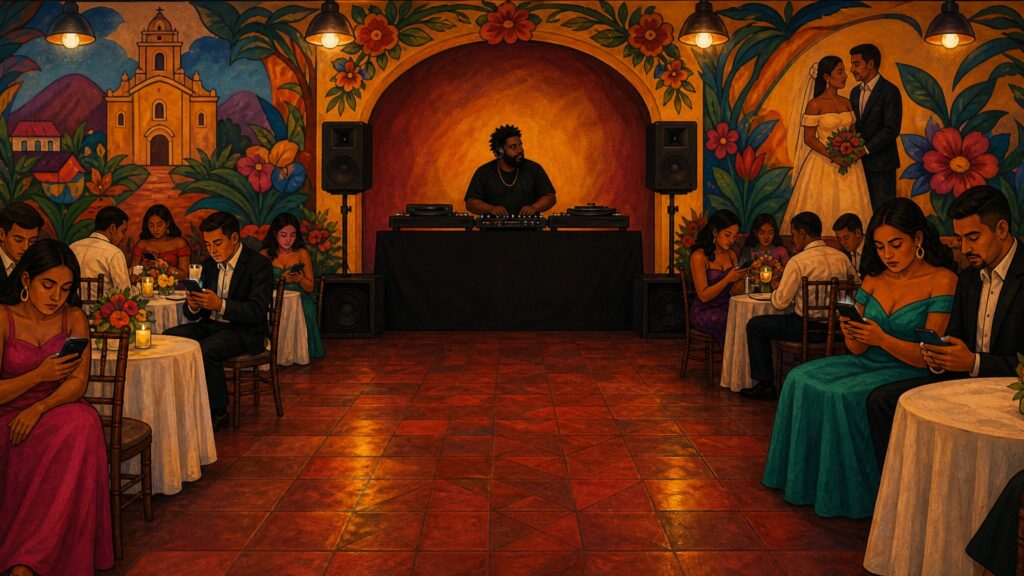
The collapse never happens all at once. It bleeds out through small behavioral tells that a static set can’t register. Guests stop making eye contact with each other while dancing and start scanning the perimeter for friends who already left the floor. The bar line suddenly lengthens, because people want a socially acceptable reason to step away from the awkward silence between tracks. Phones come out, not to film the party, but to check the time or scroll a feed, because the current song offers nothing worth capturing. These small departures compound fast, until the floor loses the critical mass it needs to keep dancing.
Why pre-planned transitions ignore room temperature
A preset list assumes the emotional arc of your event will match the schedule you printed three months ago. It almost never does. Speeches run long, dinner service stalls, the bride needs an unexpected break, and the whole musical roadmap falls out of step with the actual mood in the room. Understanding what reading the crowd actually means shows why rigid scheduling fails once human variables get involved. The software doesn’t know grandma just gave a tearful toast and the room needs a gentle R&B transition instead of the scheduled EDM drop. It plays what comes next on the list, whether or not the audience is ready for it, and the result feels amateurish instead of intentional.
Crowd Signal Mechanics vs. Static Playlists
Live performance means reading hundreds of non-verbal signals a minute and adjusting before problems become visible. A playlist can’t read a room. Only a human operator can tell the difference between a bathroom break and a permanent exit. That distinction is what separates vendors who own equipment from performers who’ve built instincts over hundreds of hours behind the decks, watching how different crowds respond to sonic shifts.
Reading micro-movements before the floor clears
Experienced DJs spot disengagement in body language minutes before anyone actually leaves. Shoulders tense when a genre shift lands wrong. Feet stop moving in rhythm even though heads keep nodding politely, and couples start talking over the music instead of through it. Active since 2023, KMBRK has built a reputation on never letting the floor sit down, and that comes from improvisation, not automation. Catching these signals early means you can fix things before the damage is done, while a preset list just keeps broadcasting the failure until someone steps in or the track ends.
Genre pivots that save momentum
Switching from Top 40 to Motown or Afrobeats takes real-time observation of who’s actually on the floor. Chicago ballrooms and rooftop day parties bring their own acoustic and energy challenges, and that means pivoting in real time between R&B, house, and Top 40. A static list might have Afrobeats scheduled for 10:30pm based on a typical flow chart, but if the younger cousins are already vibrating at that frequency by 9:15pm, waiting ninety minutes wastes the peak window. Live mixing means instant access to any genre in the library without breaking the thread holding the crowd together. Potential dead zones turn into highlights that feel spontaneous, not calculated.
Preset DJ Setlist Issues That Drain Energy
Technical execution matters as much as song selection, because audible flaws give guests permission to disengage. When a transition sounds mechanical, the subconscious brain flags the whole experience as artificial and stops treating the floor as a safe space for uninhibited movement. Looking at the technical differences between live mixing and playlists shows exactly where automation breaks down under pressure. These moments pile up through the night, eroding trust in the entertainment, until even great songs stop getting a response because the delivery feels broken.
The Psychology of Predictable Transitions
Audible gaps between tracks tell guests they can safely leave without missing anything. Mismatched BPMs create a stumbling effect, where dancers have to consciously adjust instead of flowing from one groove to the next. That cognitive load wears people out faster than continuous movement ever could, so they feel tired even when the tempo says they shouldn’t. A look at common wedding reception DJ mistakes shows how often these technical failures get blamed on song choice, when the real culprit is poor execution. Your guests don’t analyze beatmatching. But they feel when something’s off, and they go find comfort elsewhere.
Real-Time Mixing as Crowd Insurance
Continuous blending kills the silence where doubt creeps in. It removes the gap that gives people permission to second-guess their spot on the floor. Seamless transitions hold a subconscious flow state that keeps bodies moving even when an individual song isn’t a personal favorite. Track by track, the night stops feeling like a collection of songs and starts feeling like one experience, and that’s what carries momentum through the natural energy dips.
Blending tracks to maintain subconscious flow
Beatmatching and harmonic mixing physically keep guests on the floor by removing the auditory cues that usually trigger a departure. When basslines overlap and melodies resolve into new keys smoothly, the brain reads the change as continuation, not interruption. That continuity matters most during the vulnerable stretches, post-dinner or pre-last-call, when energy naturally sags. Weighing alternatives to Spotify-style wedding entertainment makes the case for why automated systems can’t replicate this. The floor stays full not because every song is perfect. It’s because the connective tissue between songs never breaks long enough for hesitation to form.
Adapting to venue acoustics and layout changes
Chicago venues run from concrete warehouse spaces with harsh reflections to carpeted ballrooms that swallow low frequencies whole. Each room demands its own EQ and volume strategy, and a USB drive can’t make that call on the fly. Layout changes mid-event, like opening the patio doors or clearing tables for dancing, change how sound travels and need an immediate response to keep the energy consistent. Live operators track these physical variables alongside crowd response constantly, making dozens of small adjustments an hour to keep the sound coherent despite the chaos around it.
Playlist DJ Problems Specific to Chicago Events
Local expectations shape what works here differently than national averages suggest. Chicago crowds bring musical literacy across generations and cultures that demands broader range than a niche playlist can offer. House music carries real historical weight in this city, so it needs respectful integration, not token inclusion, and Midwestern taste sometimes clashes with coastal trends in ways that catch out-of-town vendors off guard. Knowing that stops you from playing a culturally tone-deaf set at an event where the guests know better.
Multi-generational gatherings, common in this market, need seamless movement between eras without losing any age group along the way. A preset list might block off decades in a way that fractures the party the moment demographics shift. Live mixing weaves connections between Motown classics and contemporary hip-hop that honor both at once. Nightlife standards in this city also mean guests judge wedding entertainment against the club they were at last weekend, so an amateurish transition sticks out. Meeting that bar takes real skill built in the local scene, not a generic approach imported from somewhere else.
Vetting for Live Skill Over Song Libraries
Telling a vendor with real performance instincts from one who just owns equipment means asking questions that reveal how they think under pressure. Song libraries matter less than the ability to deploy them well when the plan falls apart. Plenty of DJs play requested songs competently, then freeze when a request conflicts with the crowd’s actual energy, or when a technical issue forces them to improvise. Hire for adaptability first and catalog size second. The best library in the world sounds terrible without situational awareness behind it.
Questions that expose read-the-room ability
Ask a prospective DJ to describe a specific moment they abandoned a planned set because of crowd feedback, and what they played instead. Ask how they handled an unexpected timeline disruption or a demographic surprise at a past event like yours. Ask about their prep beyond playlist building: venue research, contingency plans for different energy scenarios. If the answers only cover song selection or gear specs, that’s someone who treats DJing as playback, not performance, and that’s exactly the rigid execution that causes the 9:40pm wall you’re trying to avoid.
Proof points beyond the song request form
Video evidence shows crowd retention skills that a testimonial alone can’t prove. Watch footage for the moments when the floor could have emptied and didn’t, and notice what the DJ did differently right there. DJ KMBRK holds a 5.0-star rating across 19 Google reviews, built on prioritizing live crowd reading over pre-set lists, and that consistency shows up in the recorded sets. When you watch live set videos, look for sustained engagement across multiple songs, not an isolated highlight reel hiding the dead spots in between. A review that mentions energy maintenance, recovery from a slow stretch, or a genre blend that landed carries more weight than one praising a specific song choice or a nice suit, because it reflects the actual skill that keeps a dance floor from collapsing.